Wednesday, January 25, 2017

Running Update:
1/4/2017
Run

5.0 mi
48:29
1/6/2017
Run

5.0 mi
47:50
1/8/2017
Run

5.0 mi
48:44
1/9/2017
Swim

1450.0 m

1/11/2017
Run

5.0 mi
47:10
1/13/2017
Run

5.0 mi
47:46
1/14/2017
Swim

1200.0 m

1/15/2017
Run

7.5 mi
1:16:04
1/16/2017
Swim

1700.0 m

1/18/2017
Swim

1750.0 m

1/18/2017
Run

5.0 mi
49:23
1/20/2017
Run

5.0 mi
47:59
1/22/2017
Run

7.5 mi
1:14:23
1/23/2017
Swim

1600.0 m

1/25/2017
Run

7.6 mi
1:14:23

Current events have taken precedence (!) to my blogging lately, but I’m back with an update today, since NF isn’t going away anytime soon.  I’ve slowly started preparing for my spring races.  You’ll notice I’ve added swimming to my training!  I joined a Master’s Swim group this fall in the hope of improving my running performance.  We’ll see.

Here is my official 2017 race schedule to support the Children’s Tumor Foundation:

NYC Half Marathon—Sunday, March 19th
Vermont City Marathon—Sunday, May 28th
New Haven Road Race Half Marathon—Monday, September 4th
Marine Corps Marathon—Sunday, October 29th


As always, our official fund raising site is www.KRath4Jane.com and it has been updated to reflect the 2017 events.

NF Update:
The New England Journal of Medicine (NEJM) is one of the oldest and most prestigious peer-reviewed medical journals.  Last month this journal published the results of phase I of the clinical trial in which Jane is participating.  Jane was “Patient 24”, and you can actually see the plot of her tumor volume in the article.  How amazing is that??

The day the article came out I showed Jane a copy of the journal.  I told her the NEJM is a famous medical journal that I read (I have a subscription, so she has seen the journal before around our house).  I showed her the cover, which lists the articles, and I pointed out the article with “neurofibromatosis” in the title.  I told her it was an article about her medicine, written by her doctors, and that it included information about her!  She plunked right down at the kitchen table and began to read through it. 


The full article is available only to subscribers, but you can see the abstract here.
Or look for it in the library:  N Engl J Med 2016; 375:2550-256.

I pointed out that the article summarized the results of the first 24 children to take her medicine.  She asked, “Where does it say about the 24 children?” so I showed her the results section of the abstract.  She read “A total of 24 children (median age, 10.9 years; range, 3.0 to 18.5)…”  I told her that meant the average age to the kids was about 11 years, that the youngest child was 3 and the oldest was 18-1/2.  She flipped to Table 1 and started to read it line by line, following with her finger. 

The New England Journal of Medicine ©2017

The quotes are Jane’s as she read it through:

“Number of patients…24”

“Median age…10.9”

“13 boys and 11 girls.  That’s interesting—there were more boys than girls.”

“Number of patients who had previous medical interventions…19” I said that means the number of kids who had taken other medicines for their tumors before this one.  “I’m one of them.”

“Number of previous medical interventions for treatment of plexiform neurofibroma…41.  That means 19 kids had 41 different medicines.  How many medicines did I have?”  I told her first she had shots (Pegintron), then she had the medicine from Indiana (Gleevec).  “So, I had two.”  She noted that that was the same as the median number of previous medical interventions per patient (2).

“Number of previous debulking surgeries…”  I told her that meant how many children had had surgery for their tumor.  “Not me.”

“Predominant target location of plexiform neurofibroma.  Face…4.  That’s me!”  She went on to read that one patient had a head and neck tumor, 6 had a neck and chest tumor, 4 had a truncal tumor, 8 had a truncal and extremity tumor, and 1 had a whole-body tumor.  I commented that it didn’t seem to be enough patients, but she quickly added them up and said, “Yup.  It adds up to 24.”

“Progression status.  What’s that?”  I said that “progressive” was another name for “growing”, and that her tumor was growing when we started this trial.  “Mine was ‘nonprogressive’ before, when I took the shots.  It was not growing and not shrinking.”  I said she was correct—the interferon had kept her tumor stable for about a year before it became “progressive” again.

“Documented plexiform neurofibroma-related complication at baseline.”  I told her it was complications, or problems, caused by the tumor before starting the medicine.  “Oh!” she lamented, “One child had vision loss!”  Then, “What’s ‘motor dysfunction’?”   I told her it meant difficulty moving, for example, moving arms or legs.  We noted that her friend, Travis, who has a PN in his leg, has motor dysfunction from his tumor.  I pointed out, however, that Travis was not in this particular paper, because he was not in the original group of 24 children.  “Will there be another article in the magazine after the next 24 children?”  I told her probably.  She then started counting by 24: an article after 48 children, then after 72 children, then after 96 children… :)

“Pain…13.  I don’t have any pain.”

“Disfigurement.  Well, I have some, I think.  What does ‘disfigurement’ mean?”  I said it’s when something changes shape, like her cheek changed shape a bit because of her tumor.  She agreed.

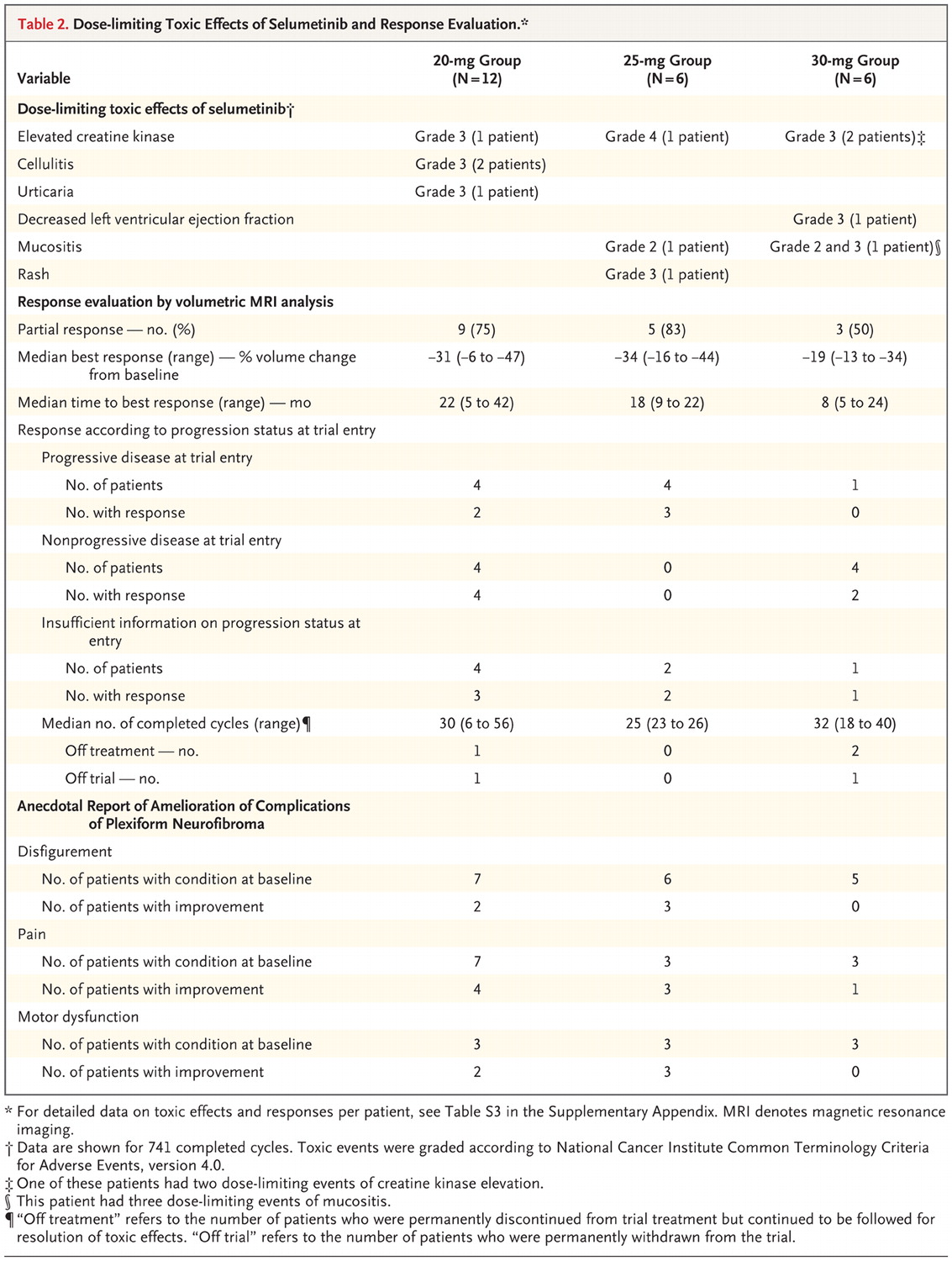
With Table 1 done, she turned right to Table 2.
The New England Journal of Medicine ©2017 

“Dose-limiting toxic effects of selumetinib.”  I told her that meant side effects that were so bad that the child had to stop the medicine.  “I had to stop it once.”

I explained what elevated creatine kinase, cellulitis, urticaria, decreased left ventricular ejection fraction, and mucositis were.  Then she read, “Rash…1 patient.  That’s me!  Maybe people will read this and wonder who was the child who got the rash!”  Then she puzzled, “It says ‘Grade 3’, but I was in grade 1 when it happened.”  I explained that “Grade 3” was referring to the severity of the rash, not her school grade :)

Figure 2. The New England Journal of Medicine ©2017

Figure 2A: “Which one am I?” Number 24.  She got a ruler and drew a line from her bar to the y-axis labeled “Percent Change in Tumor Volume” and proclaimed, “It’s halfway between -30 and -40, so it’s about -35.”  I told her she was correct: the maximum decrease in her tumor volume was measured at 33%.

Figure 2C: “Which one am I?”  I pointed it out—hers is the black plot in the middle graph of Figure 2C (25mg/m2)—and described the various sections: pre-medicine, Pegintron, Gleevec, selumetinib. 

“I feel bad for patient 3 and patient 8.  Their tumors kept growing.”  She said, “Mine grew a tiny bit,” pointing to a brief plateau in her tumor volume after 18 months on the trial.  At first Jane thought that must correspond to the month she was off the medication.  “How long does it take for the medicine to kick in again?”  I told her I didn’t know.  She answered herself confidently: “Probably a week.  So, that’s one month plus one week…  Would that cause it to grow?”  I told her the more likely reason for the plateau was that it was around this time that she went from sedated to non-sedated scans, which would affect the way the tumor was measured.

Figure 3. The New England Journal of Medicine ©2017

Figure 3: “Does it say my name?  Does it have my picture?”  I explained that medical journals don’t use patients’ names or pictures of their faces in order to maintain the patients’ privacy.  “What if the tumor is on your face?”  She answered herself, “They could just cover part of it, like this.”  She covered her eyes and forehead with her hands.  I agreed, and said the journals often use a black bar to cover a patient’s eyes.

I confess seeing the study in print in a prominent medical publication has caused me mixed emotions: on the one hand, I am thrilled that we got a chance to participate in the study and that it’s had such good results.  I’m also tickled that Jane is “published” in the NEJM!  On the other hand, it reminds me that Jane was one of only 24 “guinea pigs” for the study, and that she has a unique enough medical condition to warrant a report in the NEJM.

I have allowed myself to envision, maybe 10-15 years from now, Jane and the other 23 kids reuniting at NIH to celebrate when selumetinib finally gets FDA approval and becomes the standard-of-care for plexiform neurofibromas.  Maybe she’ll be starting medical school at that point :)


Wednesday, December 21, 2016

Running Update:
11/27/2016

13.2 mi
2:06:53
11/30/2016

7.6 mi
1:12:39
12/2/2016

5.0 mi
46:04
12/4/2016

9.2 mi
1:28:29
12/7/2016

5.0 mi
47:01
12/9/2016

5.0 mi
46:49
12/11/2016

13.2 mi
2:09:47
12/14/2016

3.2 mi
27:08

On November 27th, I passed 1000 miles of running for 2016! It's my 4th year in a row running 1000 miles, but the first time I've done it before December.  At this point I’m at 1053.7 miles, and may have to leave it at that.  I had planned to add quite a few more runs before the end of the year, but alas I've succumbed a nasty chest cold and have not run in a week.  I had hoped to try a little run today, but then I started coughing again and decided I'd better wait another day.   I hate not running!  I feel like my muscles are already atrophying.  At least it's not right before a race.  Hopefully will have a good rest over the holidays and I'll jump right back into training in January.

NF Update:
This is Akae, a 13-year-old girl in 1835 in Canton (now Guangzhou), China.
(Lam Qua, 1835, Portrait No. 01, oil painting, 61x47cm, 
Harvey Cushing/John Hay Whitney Medical Library, New Haven.)

 I came across an interesting piece of medical history recently.  Another NF Mom had called my attention to a collection of paintings by the 19th century Chinese artist Lam Qua.  The paintings were commissioned by Dr. Peter Parker, and American surgeon who studied at Yale and who was a medical missionary to China in the 1830’s. The portraits are of his patients before surgery.  As the collection is housed at the Yale Medical School Library, I decided to investigate.

Here is a link to the collection: http://library.medicine.yale.edu/find/peter-parker
I was so intrigued by these paintings!  In particular, I was taken by the little girl in Portrait No. 01, above, because of her facial tumor.  (Here is the link.)

I wrote to the Medical History Department at the library, and, amazingly, she provided me with the case history for the little girl.  (A word of caution: the report contains graphic descriptions of surgery.  You can skip this report and continue with my blog post, which will describe the important parts of the history.)

First Report Quarterly Report, from the 4th of November, 1835 to the Fourth of February 1836, Chinese Repository 1835-36, Vol. 4, p. 467-469: “Sarcomatous tumor. Akae, a little girl, aged 13. As I was closing the business of the day, I observed a Chinese timidly advancing into the hospital leading his little daughter, who, at first sight, appeared to have two heads. A sarcomatous tumor projecting from her right temple and extending down to the cheek as low as her mouth sadly disfigured her face. It overhung the right eye, and so depressed the lid as to exclude light. The parotid and also its accessory gland were very much enlarged. This large tumor was surrounded by several small and well-defined ones, the principal of which lay over the buccinators muscle. Slight prominences on other parts of the body indicated a predisposition to tumors, which I have learned, is hereditary. The mother presents a most singular appearance, being covered from birth with small tumors, some of the size of large warts, and others hanging pendent, in shape and size like the finger. Akae is the only one of her four children thus afflicted. Her general health was somewhat deranged, the tongue foul, pulse frequent and feeble, and the heat of the tumor above the natural temperature of the system. The blood vessels passing over it were much enlarged. The weight much accelerated its growth, and occasioned pain at night in the integuments around its base. The child complained of vertigo, and habitually inclined her head to the left side. According to the statement of parents, the tumor was excited into action by the small-pox, which the child had four years since, but within the last four months had attained three fourths of its present magnitude. The child was put under medical treatment for a month, during which her health decidedly improved. From the first, it appeared to me possible to remove it, yet the possibility of an unfortunate result, or even of the child’s “dying under the knife”, and the operation of the hospital being thereby interrupted or broken up, did not escape any thoughts. On the other hand, however, it was a case presented in divine providence, and it was evident that, left to itself, the tumor might terminate the life of the child, and that, from the accompanying symptoms, before a great length of time. The surgical gentlemen whose counsel I was so happy as to enjoy were all agreed as to the expediency of its removal, yet with all its circumstances, they regarded it a formidable case. Though in a Christian and enlightened land the surgeon might have undertaken it without embarrassment, it was not so here. Having often, in secret as well as in concert with others, commended the child to the great Physician, I resolved upon the undertaking, with the precaution of procuring a written instrument, signed by both parents, stating that the operation was undertaken at their desire, and that they would exculpate me from censure of the child should die in consequence of the attempt. Even the burial of the corpse was a subject of forethought and agreement with the father. On the nineteen of January, with the signal blessing of God, the operation was performed. The serenity of the sky after several days of continued rain, the presence and kind assistance several surgical gentlemen, and the fortitude of a heroine, with which the child endured the operation, call for my most heartfelt gratitude to the Giver of all mercies. A few days previous to the extirpation an evaporating lotion was applied to the tumor. An opiate was given fifteen minutes before, and wine water during the operation. The patient cheerfully submitted to be blindfolded and to have her hands and feet confined. The extirpation was affected in eight minutes. Another small tumor of the size of a filbert was also removed from under the eyebrow. The loss of blood was estimated to be about ten or twelve ounces. Not an artery required to be taken up. She vomited, but did not faint. The tumor weighed one pound and a quarter. The circumference at its base was sixteen inches and three quarters, and the length of the incision from the top to the head to the cheek ten inches. On opening it I found portions of it becoming black and two or three drachms of sanious blood of a dark chocolate color, indicating that it had already taken on a diseased action. After a nap the child awoke cheerful as usual; in the evening her pulse was accelerated and she complained of nausea, but ever afterwards uniformly said that she had no pain. No inflammation supervened, and the wound healed by the first intention. Three days after the operation, in several places of an inch or more in length, it had completely healed, and it fourteen days the whole, except a spot the fourth of an inch, was entirely healed. In eighteen days the patient was discharged.”
|Continuation of the case in the Third Quarterly Report for the term ending on the 4th of August 1836, The Chinese Repository 1836-1837, Vol. 5, p. 188:|“Akae is mentioned in the first report under date of December 27th, 1835. About three months subsequent to the removal of the original tumor, as she was walking by the river side, a coolie, carelessly passing by, thrust the end of the bamboo, with which he carried his burden, against the superciliary ridge of the right temples from which the tumor had been removed. When she came to the hospital a month after the accident, there was considerable tumefacation above the eye. It being the close of that term, she was directed to remain at home until the first of June; at which time the tumor had attained the magnitude of the former one though not exactly the same shape and others previously on the side of her face were enlarged. The new one was altogether of a different character from the former. It had the appearance of a spongy mass, (…) the general health was affected and death seemed probable and that speedily, unless its progress could be arrested by a surgical operation, while the heat of midsummer not a little increased the hazard of such a measure. (…) On the first of July the operation was performed. On the first incision being made a large quantity of greenish fluid gushed out from cells of disorganized matter. The tumors above the ear were all removed (…) There was a loss of sixteen ounces of blood. (…) The constitution suffered much more than in the former instance, but she has very much regained her strength and the flesh she had lost, and now looks forward to the prospect of returning home in a few days, with the hope of enjoying a happy reprieve from the grave.

I confess I gasped aloud when I read the details of the case—I am convinced this little girl had NF!  

Neurofibromatosis (NF) is a hereditary condition that leads to, among many other things, the development of both benign skin tumors called neurofibromas, and larger benign tumors of nerves called plexiform neurofibromas.  NF wasn’t described until Friedrich von Recklinghausen did so in the late 1800s.  However, the description of this girl in the case history, the description of her mother, and her appearance all seem to indicate NF to me.  First, the location of her tumor seems characteristic for a facial plexiform neurofibroma, the same type of NF tumor that Jane has on her cheek.  Parker also comments that "the large tumor was surrounded by several small and well-defined ones".  He also mentions that "parts of the body indicated a predisposition to tumors, which I have learned, is hereditary."  The kicker for me is his description of her mother: “The mother presents a most singular appearance, being covered from birth with small tumors, some of the size of large warts, and others hanging pendent, in shape and size like the finger.”

In Parker’s time, any soft tissue tumor could be referred to as a “sarcoma”. This does not rule out the possibility that Akae’s tumor was a neurofibroma, since it was not until after the development of cellular pathology during the middle of the 19th century that sarcomas were separated from other tumors based on their tissues of origin. (Peltier LF, “Historical Note on Bone and Soft Tissue Sarcoma”, J Surg Oncol. 1985 Dec;30(4):201-5.)

Parker did operate on the poor girl, and sadly, within a year later "the tumor had attained the magnitude of the of the former one".  This is often the case with plexiform neurofibromas, which is why surgical excision is not the preferred treatment option.

I myself suspect the regrowth of the tumor has nothing to do with the trauma that Parker blames—if the recurrence was due to trauma, I would expect the contents to be fluid, not "spongiform".  If it were an infectious process, I would have expected the girl to have a fever, or even to have died after 6 months. (She originally presented in December, with her re-operation in July of the following year.)

Akae has captured my heart, and perhaps my imagination.  I am clearly projecting my feelings for my own daughter onto her.  However, even if this little girl did not have NF, I feel a connection to her because of her tumor.  It amazes me that almost 200 years ago, in another country half way around the globe a little girl like my daughter was experiencing the same pains, limitations, perhaps prejudices.  It makes history and the world seem a little smaller.  And the emotions the portrait evokes in me is a testament to the skill of the artist.

I’d like to mention that the NF Mom who brought my attention to the collection is Rachel Mindrup.  She is herself an artist in the Midwest has a son with NF.  In addition to her regular artwork, she frequently paints portraits of individuals with NF.  Please visit her website: http://www.rmindrup.com/.

Jane and Family Update:

We will spend Christmas in Connecticut with my mother, aunt, sister and brother, then will head to Canada to ring in the New Year with Todd’s family.  Have a safe and wonderful holiday, everyone!  May 2017 bring many good things.

Friday, November 25, 2016


Running Update:
10/16/2016
5.0 mi
48:00
10/19/2016
5.0 mi
47:10
10/22/2016
3.2 mi
30:32
10/26/2016
3.2 mi
29:28
10/28/2016
5.0 mi
46:48
10/30/2016
7.6 mi
1:13:32
11/2/2016
7.6 mi
1:14:05
11/4/2016
5.0 mi
46:00
11/6/2016
9.1 mi
1:28:27
11/8/2016
3.2 mi
29:19
11/9/2016
7.6 mi
1:13:37
11/12/2016
5.0 mi
48:09
11/13/2016
13.1 mi
2:12:14
11/16/2016
7.6 mi
1:14:15
11/18/2016
5.0 mi
45:47
11/20/2016
9.1 mi
1:29:00
11/24/2016
5.0 mi
40:32

I haven’t updated running log since the Hartford Marathon, for various reasons, but it’s time to report in:  I’m at 992.5 miles for 2016, closing in on 1000.  This is the first time I’ll (hopefully) reach 1000 miles before December.

Our fundraising total for 2016 has increased since I last wrote, too:  were now at $16,714 for the Children’s Tumor Foundation ($24,270 for the Children’s Tumor Foundation and NF Northeast combined).  Thank you, everyone!  After Black Friday and Cyber Monday, if you’re looking to participate in #GivingTuesday, look no further than our fund-raising site:  www.KRath4Jane.com

Thanksgiving Update:
We had our annual pre-Thanksgiving pasta dinner Wednesday night with our dear friends, Neil and Marcia.  Readers of this blog know that Neil, in addition to being one of our oldest friends, is my virtual running partner.  For the past 8 years Neil and Marcia have come to our house the evening before Thanksgiving and the kids help them prepare a vegetarian dinner. We have sweet potato, kale, pine nuts, and sage over egg noodles.  (Comfort food!)  Thursday morning Neil and I run in the Madison Turkey Trot (we both set PRs this year!) with the others cheering us on.  After lunch Neil and Marcia head home, and the kids, Todd and I head to my Mom's where we have a traditional Thanksgiving dinner with her and her sister, Anne.

Today we took the kids to see Fantastic Beasts and Where to Find Them, since we're all Harry Potter geeks :)

All in all, a lovely few days.

Wednesday night dinner preparations.
Neil and Alec tackle the kale...


...while Helen's got the sweet potato...

...and Jane manages the pine nuts.

Jane washing greens with Marcia


Thanksgiving morning, Neil and Kristy trying to stay warm before the Turkey Trot. 
Good friends <3


At the start

There go the trotters!

Waiting patiently for the runners

Kristy at the finish

Mother and son

With the mild weather these past few days, the kids have been enjoying the outdoors.  Helen spent quite a bit of time (and used her considerable talent) decorating our driveway before our guests’ arrival!